Blog
Published
Optimize for Understanding
Automation sounds simple. Make machine do work.
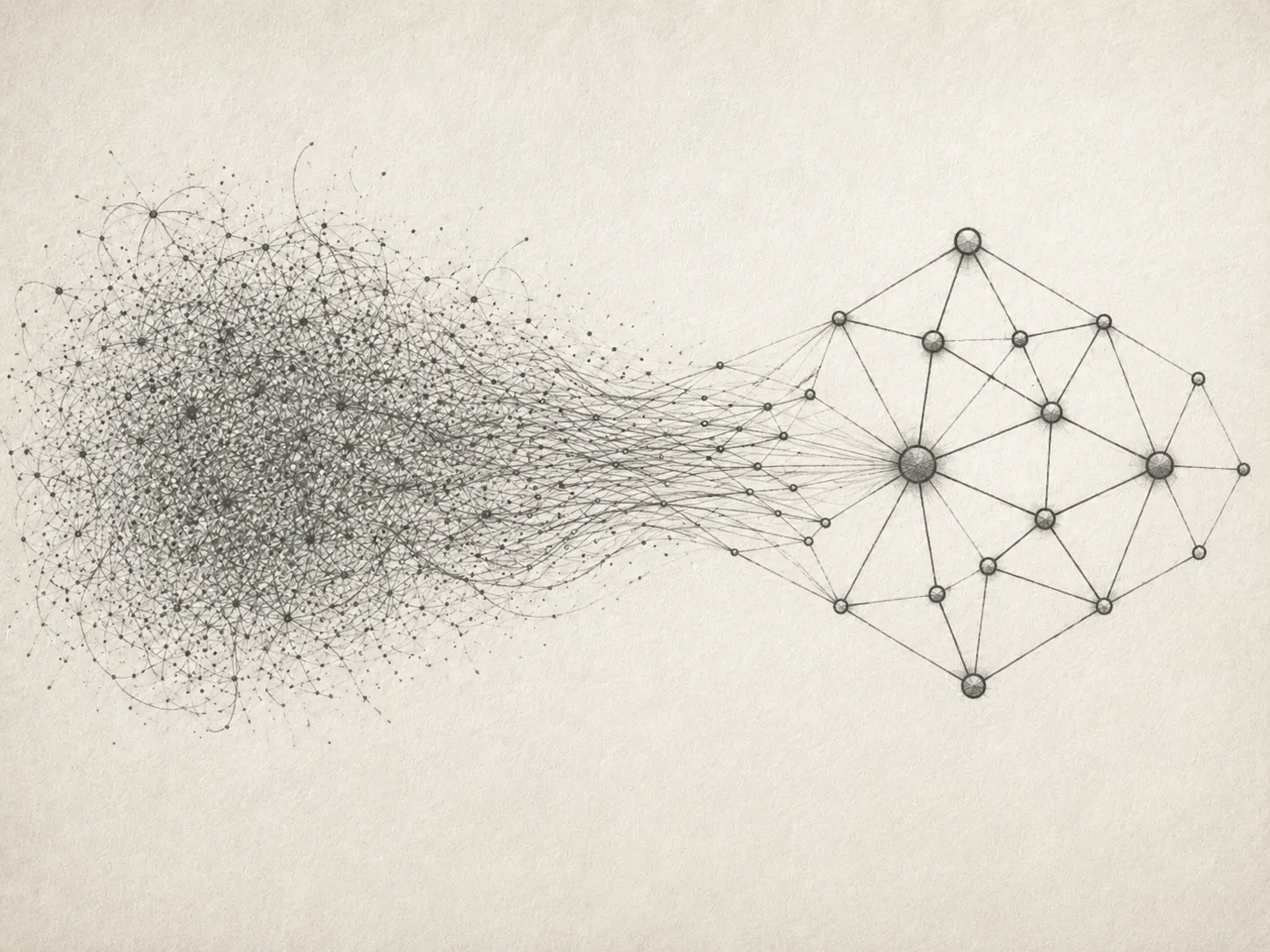
But first:
What work? Why this work? For whom?
What future are we trying to create?
What future are we trying to avoid?
Machine can act.
But someone must understand the chaos first.
That is the problem.
Aha! moments. Build understanding.
- Understanding the world is the bottleneck to thinking.
- The world is an unbounded system with unpredictable behavior. Chaos.
- An outcome is a possible state of a system.
- Formulating an outcome means choosing a future state of the system.
- That future state may be desired or undesired.
- Therefore an outcome is not purely objective. It is a consensus problem.
- Consensus is concentration around a shared outcome.
- Consensus around an undesirable outcome is maladaptive consensus.
- Intent is a decision that constrains future system states.
- One outcome may relate to another. It may also relate to intents.
- Related outcomes and intents form a problem domain. Or simply: a semantic graph.
- A graph gives structure to otherwise ambiguous future states.
- Structure reduces the number of possible interpretations.
Or simply: reduces uncertainty. - High uncertainty prevents action. Low uncertainty makes action obvious.
- A problem without structure requires thinking.
- A structured problem can be acted upon.
- A sufficiently structured problem becomes the solution to itself.
- An insufficiently structured problem keeps producing chaos.
- Problem solving is creating structure from chaos.
- Therefore thinking is problem solving before the structure exists.
We can automate action. Not understanding.
Therefore we should optimize for understanding.